
The Wu-Tang Clan and China’s (Unintentional) Soft Power
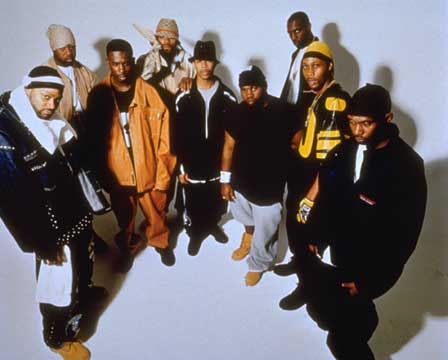 In early 1992, over a decade of Beijing’s soft power aspirations led to the founding of the first Confucius Institute, traditional Chinese culture found unintentional ambassadors (of a sort) in the unlikeliest of places. In the slums of Staten Island, a young Robert Diggs was forming hip-hop’s first real super-group, and he was using a Chinese aesthetic to help brand it.
The name “Wu-Tang Clan” itself is, obviously, Chinese, originating from a kung fu film called Shaolin vs. Wu Tang. The group peppered their first album with audio clips from dubbed Chinese films (especially the aforementioned film), samples from traditional Chinese musical instruments, and esoteric references to kung fu legends — amidst, of course, the braggadocio battle-style rhyming that has been popular in one form or another since rap was invented.
The final product might have left something to be desired, from a Chinese perspective. Probably, this was not exactly the image of China they wanted presented to the public1:
Still, the Wu-Tang Clan spread Chinese kung fu and the Shaolin name — which they adopted to refer to their Staten Island home — to a whole audience that didn’t really know anything about China.
Of course, they still don’t. Nearly two decades later, kung fu is one of the few things most Americans associate with China. The Shaolin temple is a household name, or close to one, which certainly puts it ahead of every other Buddhist temple on the face of the planet. Of course, not all — not even most — of the credit for this belongs to Wu-Tang. But Wu-Tang’s influence in spreading Chinese kung fu and even traditional Chinese music indicates something about soft power that Beijing may have missed; namely, that it is most effective when it is derivative and not directly controlled.
By derivative, what I mean is that when one culture (for clarity, we’ll call it C1) interacts with something from another culture (C2), people are inevitably going to take parts of that culture (C2) and assimilate them into something that already exists in their own (C1). RZA and the Wu-Tang took Chinese kung fu and the Hong Kong kung fu flick aesthetic, mixed it with hip hop, and the results were explosive. They weren’t Chinese, of course, but they were a gateway into things that really were Chinese — like actual Kung Fu.
This method seems to be more effective than the more direct (and thus more easily controlled) soft power attempts we see from Beijing. CCTV International and Confucius Institutes, to be frank, are probably too Chinese for mainstream consumption. They are, of course, easily controlled by the government. But they haven’t been as effective in spreading Chinese culture throughout the US as a group of black guys from Staten Island. Which is to say, of course, they haven’t been effective at all.
America’s soft power, on the other hand, is pretty undeniable, and I would submit that this is in large part because it comes mostly from non-government organizations, and thus is much more flexible. It can be changed and adapted to fit local cultures while still representing the “American way” (as KFC and McDonalds, for example, adopt their menus to fit local tastes). It can lead to derivative work that outpaces the original while still retaining some of its cultural influence (as in Jay Chou’s fusion of elements of American hip-hop and dance with C-pop to create something much more marketable to a Chinese audience than, say, 2pac).
Of course, there are also dangers in this approach. Precisely because American soft power output cannot be controlled, the image of America that is presented is not wholly positive, or even accurate. Americans who’ve been in China more than a few second are probably familiar with the question “How many guns do you have?” (because we all own guns, thanks Hollywood!), and may have heard terrible things about American cities (one of my Chinese teachers in Harbin once told me she didn’t dare travel to the US for fear of being killed in a gun battle on the streets).
Still, the sooner Beijing can get over the idea that it’s possible to present China without exposing some of the less perfect bits, the better. In fact, the sooner it accepts the fact that it cannot really effectively control soft power at all, the better. Soft power is a cultural export, and as much as Beijing likes to think it controls Chinese culture, we need look no further than the Wu-Tang Clan to see that the idea of “Chinese culture” is far too amorphous to be defined by a cabal of old men.
Han Han has suggested in speeches that China cannot be a cultural power while its culture is being controlled, and he’s right. Obviously, cultural censorship inhibits domestic development as well, but internationally speaking, government control is the ultimate mood-killer. No part of Chinese culture will spread through the US like wildfire because of the Confucius Institutes — this is not to say that they’re totally useless, of course, but they’re not nearly as effective real cultural exports could be.
If RZA can spread the word about the Shaolin temple through a Christian country via dubbed kung fu tapes funneled into hip-hop albums and music videos, imagine what China’s vast army of creative people if they were unmuzzled and unleashed.
See this article I translated a while ago for CNReviews for an interesting discussion of China’s soft power tactics. (Or, alternatively, click the link for pretty photos of Zhang Ziyi).
- Although one wonders if perhaps in private moments Hu Jintao doesn’t occasionally say to himself, “Zhongnanhai ain’t nothing to fuck wit!” [↩]

Related posts:


The word is bond son. Great post.
[...] posted an interesting retrospective on the ChinaGeek’s blog this week, discussing soft power, censorship and the how the Wu-Tang [...]
You can listen to the song on Youtube…so you might try this
http://v.youku.com/v_show/id_XNzQ2NjE1NzI=.html
I reached this blog by accident, but I found very interesting. A greeting.
Surely that should be “我党 ain’t nothin’ to fuck wit’?”
While I always appreciate a Wu-Tang Clan reference, it would be wise to note that much of the dissemination of kung fu was a result of Blaxploitation films in the 1970s, screened in predominantly black neighborhoods in America, which were heavily influenced by kung fu films during that time period (as many of the action scenes utilized those “fighting styles”). It is no doubt how the Wu-Tang Clan was later influenced when they began recording hip-hop music. Also, because inner city cinemas often paired a feature film with a second movie, kung fu films were often the opening act when it came to going to see a movie.
Think he said exactly that, though maybe not in such specific terms.
great piece. definitely engages the possibilities, imaginings, as well as shortcomings of appropriation and intercultural exchange.
am a big fan of your posts and am digging the new website.
Wu Tang also helped to spread the word about traditional Chinese torture methods
“I fucking sew your asshole shut…and keep feeding you, and feeding you”
“I’ll put your nuts on a table, just your nuts, and smash em with a spiked bat”
hahahahahaahaa
Yanks are obsessed with power.
C. Custer - you did catch the History Channel’s show, “How Bruce Lee Changed the World”, right? Bruce’s cinema work and his book on martial arts had a deep impact on the African-American community, at least deeper than most folks thought in the past.
The Wu is so raw - I love them. Did you ever see the RZA and GZA in Coffee and Cigarettes with Bill Murray? Freaking hysterical.
[...] CHINA GEEKS: Post about Wu Tang Clan and the Soft Power. [...]